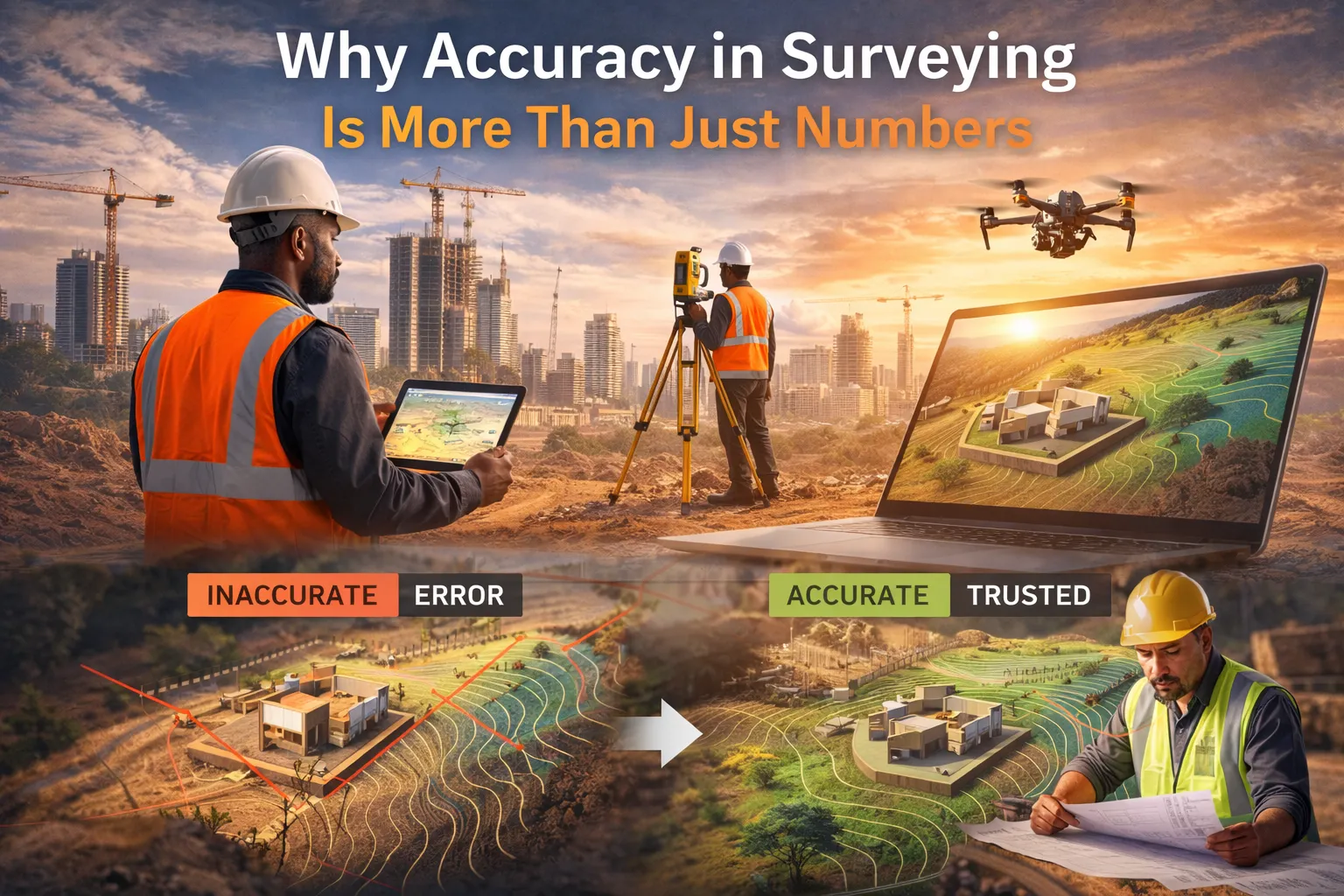
In surveying, accuracy is often seen as a technical metric—centimeters, millimeters, coordinates. But in reality, accuracy is not just about numbers. It is about the decisions built on top of those numbers.
A small error in data can lead to large consequences in execution.
The Hidden Cost of Inaccurate Data
At the early stage of any project, survey data becomes the foundation. Engineers, planners, and stakeholders rely on it without questioning its correctness.
If the data is even slightly off:
- Designs may not align with ground reality
- Construction errors can increase
- Project timelines get affected
- Costs escalate due to rework
What appears to be a “minor deviation” at the survey level often becomes a major issue during execution.
Accuracy vs Precision: A Common Misunderstanding
Many people confuse precision with accuracy.
- Precision means consistency in measurements
- Accuracy means correctness relative to the real world
You can have highly precise data that is consistently wrong.
True surveying excellence lies in achieving both precision and accuracy together.
Technology Helps — But It’s Not Enough
Modern tools like drones, LiDAR, and RTK systems have significantly improved data collection. However, technology alone does not guarantee accuracy.
Accuracy depends on:
- Proper planning before data capture
- Correct calibration of equipment
- Ground validation and checks
- Clean data processing workflows
Without these, even the best equipment can produce unreliable outputs.
From Data Collection to Decision Making
Surveying is not just about collecting data—it’s about delivering usable information.
Good survey data should be:
- Structured and organized
- Easy to interpret
- Ready for integration into design systems
- Reliable enough to support critical decisions
If data cannot be used directly, its value is limited.
The Real Benchmark
The true benchmark of good surveying is simple:
Can this data be trusted without rechecking?
If the answer is yes, the survey has done its job.
A Shift in Mindset
As projects become more complex and timelines tighter, the importance of reliable data continues to grow.
Surveying is no longer just a preliminary step—it is a core part of the decision-making process.
Understanding this shift is essential for anyone working in infrastructure, construction, or geospatial domains.