The Processing Gap in Modern Geospatial Workflows
Across global markets, drone and LiDAR-based data acquisition has scaled rapidly. High-resolution datasets can now be captured efficiently across infrastructure, mining, urban development, and energy sectors.
However, processing workflows have not evolved at the same pace.
Despite advances in capture technology, many organizations still operate within constraints such as:
- Delayed processing cycles after data collection
- Dependence on high-cost local infrastructure
- Limited compute utilization tied to working hours
As a result, datasets collected during the day often remain idle before processing begins—introducing delays in analysis, decision-making, and project execution.
Rethinking Processing as a Continuous Operation
Traditional geospatial workflows follow a sequential model:
Collect → Wait → Process → Deliver
This structure inherently creates latency between stages.
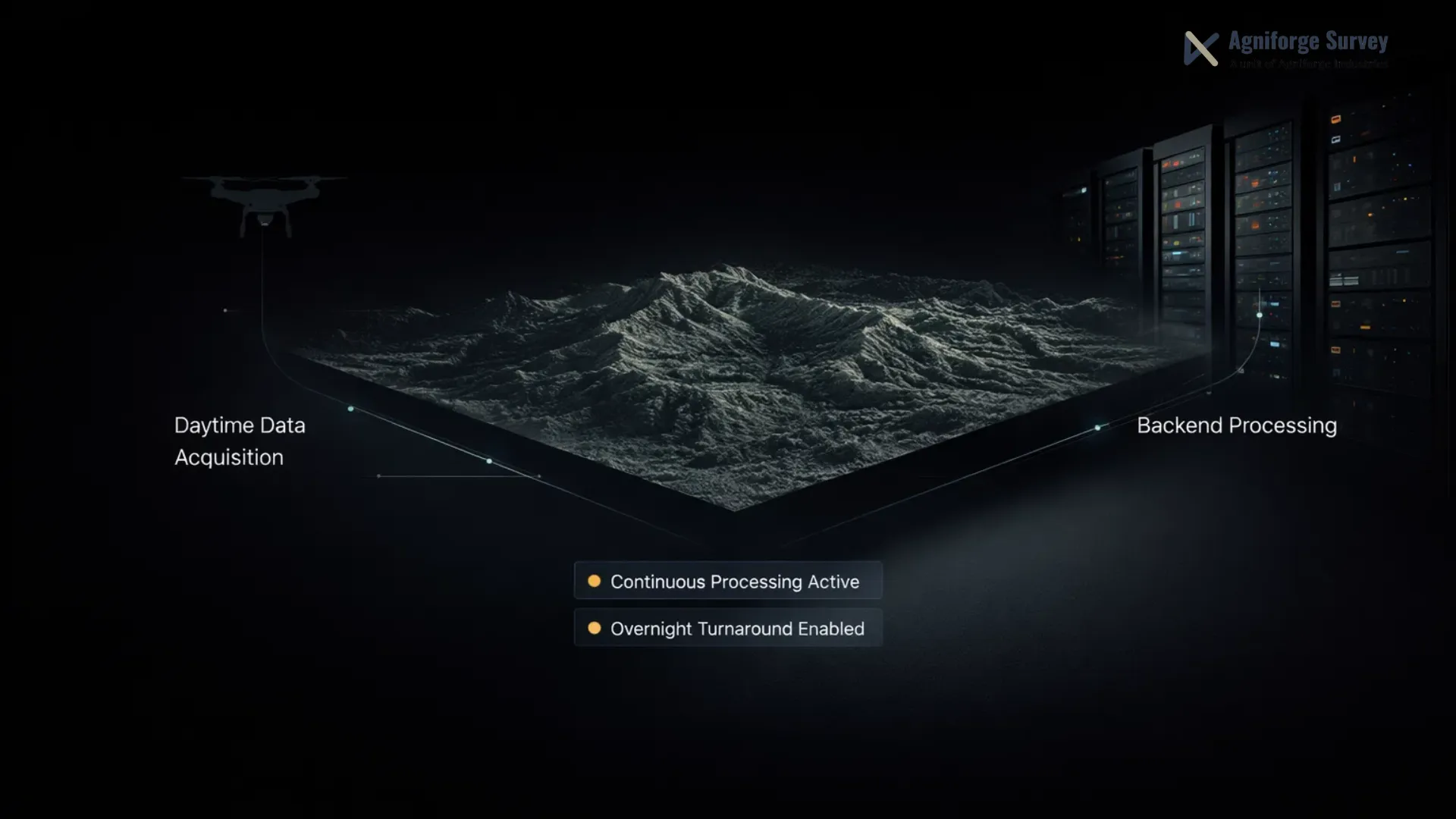
A more efficient approach is to treat processing not as a separate phase, but as a continuous, globally distributed operation—where computation begins as soon as data is available, independent of local working hours.
This shifts the workflow to:
Collect → Process (in parallel) → Deliver
Leveraging Timezone Distribution for Always-On Processing
Agniforge operates on a model where global timezone differences are used as an execution advantage.
As field teams across:
- The United States
- The United Kingdom
- Europe
complete their daily data acquisition, processing pipelines are already active within our infrastructure environment.
This enables:
- Immediate initiation of processing upon data transfer
- Overnight computation cycles
- Delivery of processed outputs by the next working day
Instead of idle gaps between capture and computation, workflows transition into a continuous 24-hour processing cycle.
Eliminating the Need for Local High-Cost Infrastructure
Processing high-resolution drone and LiDAR datasets typically requires:
- GPU-intensive compute environments
- High-memory systems
- Scalable storage infrastructure
For many organizations, this results in significant capital expenditure and ongoing operational overhead. Additionally, such infrastructure often remains underutilized outside active processing windows.
By externalizing processing into a continuously active environment, organizations can:
- Avoid infrastructure ownership costs
- Reduce operational complexity
- Scale processing capacity on demand
This represents a shift from infrastructure-heavy models to efficiency-driven execution systems.
Global Processing Cost Dynamics (Indicative)
Processing costs are influenced not just by compute, but by infrastructure ownership, labor models, energy costs, and utilization efficiency.
Based on industry-aligned estimates, effective processing costs across regions typically fall within the following ranges:
Region / CountryEffective Cost (USD / GB)Turnaround SpeedPrimary Economic ConstraintJapan$6 – $10Ultra-FastHigh labor & infrastructure costsGermany$5 – $9FastEnergy costs & skilled workforce pricingUnited States$5 – $9FastProfessional service & infra overheadUnited Kingdom$4 – $8ModerateOperational & administrative overheadRussia$3 – $6ModerateLimited access to licensed ecosystemsChina$2 – $5FastScale-driven but hardware-restrictedIndia (Agniforge)$1 – $2Continuous / OvernightOptimized infrastructure + timezone leverage
These figures represent aggregated operational costs across compute, software, storage, and labor, and may vary based on dataset complexity and processing methodology.
In many developed markets, inefficiencies in infrastructure utilization further increase the effective cost per dataset.
Agniforge Processing Model
By integrating:
- High-performance GPU clusters
- Optimized processing pipelines
- A globally distributed execution model
Agniforge delivers:
- Up to 70% cost reduction compared to traditional models
- Overnight turnaround cycles aligned with client timezones
- Consistent, high-quality outputs at scale
All without requiring clients to invest in or manage processing infrastructure.
Impact on Global Operations
This model enables measurable improvements across enterprise workflows:
- Accelerated Decision Cycles
- Processed data is available at the start of the next working day
- Operational Continuity
- No idle gap between data capture and computation
- Scalable Throughput
- Ability to process multiple large datasets in parallel
- Standardized Output Quality
- Consistent processing pipelines across projects
Positioning for Global-Scale Execution
As geospatial datasets continue to grow in size and complexity, efficiency will increasingly depend on how processing systems are structured—not just on the tools being used.
A globally distributed, continuously active processing model enables organizations to:
- Reduce dependency on local infrastructure
- Improve turnaround time
- Scale operations without proportional cost increases
High-speed geospatial data processing is no longer defined by infrastructure ownership alone.
It is defined by how effectively processing systems operate across time, scale, and workflows.
By aligning data acquisition with globally distributed processing pipelines, organizations can eliminate delays, optimize costs, and enable continuous execution.
This is not an incremental improvement.
It is a structural shift toward always-on, globally integrated geospatial processing systems.